fireflyline
  • Home
  • Services
  • Digital Creation
  • About
  • Blog
  • Contact

Insights

Reviewing Nested Graded Patterns Controls Clothing Fit

4/28/2016

2 Comments

 
Sally, one of your best customers called this morning and said the buttondown shirt she ordered doesn’t fit the same as the previous styles she bought from you. You start investigating and find the latest item Sally purchased was made at a new factory.
​

You have fit every style on the same fit model. You reviewed the patterns from the new factory with each fit sample. The pattern shapes are consistent with the blouses Sally has previously purchased. Sally is a size 16, so you check your graded measurement specification. The size 16 measurements matches your previous styles. You measure a size 16 shirt and it measures correctly. What could be wrong?

Grading
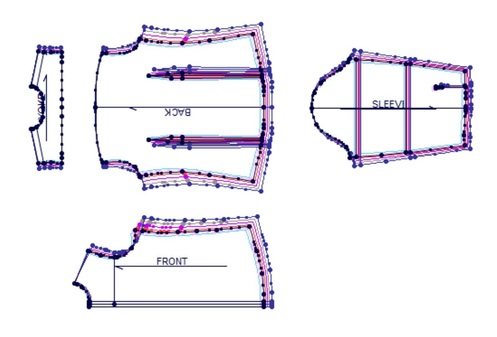
The final step in fit consistency is the grading. A graded measurement set is only one step in validating the grading is consistent. The other step, is checking a nested graded pattern. A nested graded pattern shows the patterns for each size stacked together.
Picture
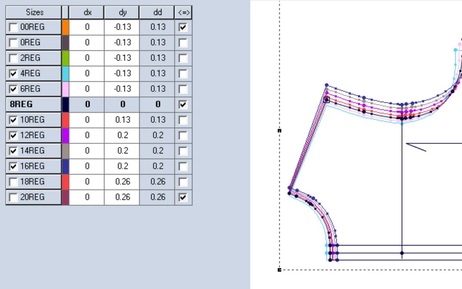
Each point on the pattern has an X and Y axis. Uh, Oh! Flashbacks of high school geometry! The image below shows the grade for the shoulder of the shirt for sizes 4-16. In this case the grade is half of the across shoulder measurement on the measurement specification. Remember, you are looking at half the pattern.
Picture
Picture
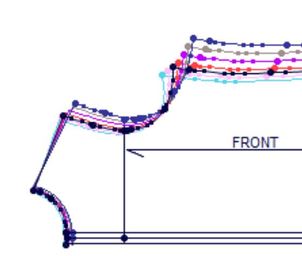
Problems found in graded patterns usually don’t come from the points that match up to the graded measurements. The most frequent issues are when proportions are not maintained. For instance, the image to the right shows a pattern with a shoulder slope that decreases and increases by size. You could give a shoulder slope measurement on your graded specs, but it is a difficult measurement for quality auditors to check. The shape along the lower armhole curve is also flatter, which can’t be controlled on a measurement specification.

How do you prevent these problems?
  1. Send the factory a nested graded pattern to follow from a previous style that is graded correctly.
  2. Require the factory to send the graded pattern for review before starting production.

If you don’t understand grading well enough to review the pattern, find someone who does. And don’t feel that you need to be an expert. Graders can make errors like everyone else. The best novelists still need copy editors to catch basic grammar errors.


Do you need technology?

No, you can check a paper version of a nested grade. You’ll need a clear plastic ruler and extra time to ship patterns back and forth.

The advantage to electronic patterns is speed. Grading is faster. Grading from whole sections can be copied. For instance, once the front pattern piece is graded, the points can be copied to the back. Patterns can be passed back and forth via e-mail for review. Nested graded patterns can easily be separated into separate sizes for use in making a marker.

​Many brands and factories will make the first patterns by hand on paper. Once the style is fit approved, they will digitize the pattern to create an electronic file. Electronic systems can then be used for grading and marker making. Even if the pattern is graded electronically, they can still print a copy and send to you for review.
2 Comments
Christopher M. Peek link
12/30/2023 12:19:23 am

I always wondered why clothing from different factories fit differently. This blog explained how reviewing nested graded patterns ensures consistency. It's all about maintaining proportions and controlling measurements in <a href="http://www.epsilonpatternsandgrading.com/">grading and markers</a>. Really helpful insights!

Reply
Ladyboy Massage Greenburgh link
3/19/2025 02:14:36 pm

I find it very helpful to learn about grading techniques.

Reply


Leave a Reply.

    Category

    All
    Apparel Development
    Digital Product Creation
    Fit / Patternmaking
    Garment Construction
    Quality
    Speed To Market

Home
​Fit Improvement

3D Virtual Samples
About
Contact

Blog
  • Home
  • Services
  • Digital Creation
  • About
  • Blog
  • Contact